Symposium inaugurates a new series, Book Exchanges, with Matthew R. McLennan’s review of Devin Zane Shaw’s Egalitarian Moments: From Descartes to Rancière (Bloomsbury, 2016) and Shaw’s review of McLennan’s Philosophy, Sophistry, Antiphilosophy: Badiou’s Dispute with Lyotard (Bloomsbury, 2015). Book exchanges put contemporary scholars into dialogue through mutual review and critique of their recent publications with the aim of establishing intersections and points of reinforcement between works that speak from different standpoints or different disciplines; in the case of McLennan and Shaw, both authors aim to outline a radical and militant philosophical approach informed by Badiou, Lyotard, and Rancière. Such an exchange is apposite, given that McLennan and Shaw are currently co-authoring a book on the political thought of Miguel Abensour. –Eds.
Showing posts with label Alain Badiou. Show all posts
Showing posts with label Alain Badiou. Show all posts
Thursday, July 7, 2016
Book Exchange: McLennan and Shaw
These days, the time I used to spend blogging has been expended on being managing book review editor for Symposium and the CSCP. That does not mean that Matt and I have ended our philosophical back-and-forth. Over at Symposium, we have reviewed each other's books:


Saturday, October 24, 2015
Available Now: Philosophy, Sophistry, Antiphilosophy
Matt McLennan's first book, on Badiou and Lyotard, is now available in hardcover.


I said "first book" because Matt and I are planning on co-authoring and completing a book entitled "A Hermeneutics of Emancipation: A Critical Introduction to Miguel Abensour" within the next few years. I also hear that he's got some other project on the go as well.
We'll be swapping our recent books during reading week, so I hope to be able to say something about Philosophy, Sophistry, Antiphilosophy either on the blog or in actual review form sometime soon. From what I know about Matt's work, his argumentation style is both merciless and sympathetic. I'm not quite sure how he does it, but it makes for good reading.
Tuesday, September 1, 2015
It's Out of My Hands
I got word today that Egalitarian Moments has gone to press. It's completely out of my hands now. But this post isn't so much about EM as it is about another book. One of the other long-time contributors to the blog also has a book coming out, and I don't think he's used this space for shameless self-promotion (yet). So, I'll tell you that Matt McLennan's first book, Philosophy, Sophistry, Antiphilosophy: Badiou's Dispute with Lyotard will also be published by Bloomsbury this fall. Here is the blurb:
Alain Badiou's work in philosophy, though daunting, has gained a receptive and steadily growing Anglophone readership. What is not well known is the extent to which Badiou's positions, vis-à-vis ontology, ethics, politics and the very meaning of philosophy, were hammered out in dispute with the late Jean-François Lyotard. Matthew R. McLennan's Philosophy, Sophistry, Antiphilosophy is the first work to pose the question of the relation between Lyotard and Badiou, and in so doing constitutes a significant intervention in the field of contemporary European philosophy by revisiting one of its most influential and controversial forefathers.
Badiou himself has underscored the importance of Lyotard for his own project; might the recent resurgence of interest in Lyotard be tied in some way to Badiou's comments? Or deeper still: might not Badiou's philosophical Platonism beg an encounter with philosophy's other, the figure of the sophist that Lyotard played so often and so ably? Posing pertinent questions and opening new discursive channels in the literature on these two major figures this book is of interest to those studying philosophy, rhetoric, literary theory, cultural and media studies.
Friday, March 25, 2011
Alain Badiou, "Pocket Pantheon"
 (Verso, 2009)
Badiou's book collects eulogies to certain recent-contemporary giants of French intellectual life. All are beautifully written, most shed light on Badiou's own philosophy, and some are excellent introductions to their subject matters.
The eulogy to Derrida is probably the best in the collection, precisely for how it combines humour, clarity and sympathy in its reconstruction - I hope you'll pardon me here - of deconstruction. Also particularly notable are the entries on Sartre, Althusser and Lyotard. The impression is reinforced that for Badiou, there are no problems of a strictly or abstractly philosophical importance; for a philosophical "interventionist", in a constrained but important sense the philosophical is the concrete. This accounts for his rooting of interpersonal sympathies and dissonances at a level of abstraction that is often surprising and counter-intuitive. Through humour, sadness, love and ire, the force of Badiou's personality shines through in virtually every eulogy, giving body to the austere rigour of his own philosophical work.
Though highly interesting, the book is more for browsing than reading cover to cover, a supplement to one's studies at best. For example, the discussion on the Kantianism/Spinozism of Francoise Proust means nothing to me at this point; as a North-American student of French theory, there's a fair bit regarding more minor personalities that eludes my grasp. The main attraction for me was the prospect of reading Badiou on his philosophical contemporaries, both allies and rivals. I was rewarded with the usual aesthetic experience of his writings, but also a clearer picture of his self understanding vis a vis French intellectual life. I hesitate however to recommend this text for systematic study. If you're curious about, say, Sartre's influence on Badiou, by all means turn to the essay in this book. We must, however, pick our battles.
Friday, March 11, 2011
Mehdi Belhaj Kacem on Tunisia and French Intellectuals
Via Progressive Geographies: Mehdi Belhaj Kacem, a French-Tunisian critic, weighs in (an excerpt in French here) on events in Tunisia and the response of French (and other) intellectuals. Interestingly enough, the declarative mode in which he operates reminds me of the two intellectuals that he is criticizing:
This is a fact that the Badious and the Zizeks of the world mustn’t make us forget, and especially not a Tunisian in 2011: the Stalinist and Maoist regimes were thoroughly abominable. A Chinese woman whose family actively participated in the Cultural Revolution told me that for her it was worse than Auschwitz. As far as that’s concerned, one really has to beware of the shortcuts one takes, playing at a trendy leftist in the comfort of a bourgeois academic apartment. The “Badiou affair” may very well blow up in our faces just as much as the “Heidegger affair.” What I’ve read from Badiou and Zizek on the Tunisian revolution is absolutely useless. Tunisian philosophers have told me they regret that a Deleuze, a Foucault, a Derrida isn’t still around. They would have found the right, resonant words to take the measure of the event. I find the silence of people like Nancy and Rancière regrettable. Their sensitivity is totally right for what has happened.
I can't say that I was too impressed by what Badiou or Zizek had to say thus far. What MBK proposes, a kind of cross between Situationism, Badiou, and Kojève, is not, however, unproblematic. It's a leap from Tunisia (my emphases in bold)...
That’s the reason why the Tunisian event is already a historic event: the Tunisians are collectively experiencing freedom and, in the truth of the event, we see that a people that experiences freedom also experiences equality. That’s the hard lesson that the Tunisian event gives to our academic Stalinist dinosaurs.
Kojève said, rather humorously: “They take me for a leftist Hegelian. But I’m a right-wing Marxist.” He said that Fordism was part of Marxist politics and that he’s the one who thought up the Marshall plan. I’d rather be that kind of right-wing Marxist than a postmodern leftist fascist.
I might be wrong, but isn't "right-wing Marxist" code for "Stalinism?"
Monday, June 28, 2010
Alain Badiou, "Polemics"

(Verso, 2006)
Unsurprisingly, Canadian mainstream media is near unanimous in its reading of this weekend's G20 protests. The basic picture is that certain "anarchists" have created - you guessed it! - "anarchy" in Toronto, and are now in the process of being duly rounded up and punished. Democracy [sic] is saved! The Ottawa Sun, not fit to line an animal's cage, has even gone so far as to paint the clashes solely in terms of poor, defenceless riot cops harrassed by rocks, molotovs and bottles of urine. No mention of police wading into the supposedly safe "free speech zone", clubbing and pepper-spraying peaceful protesters.
To be clear: there has been violence on both sides. What I take issue with is that whereas property destruction by certain militant factions is almost universally denounced as "violence" or "terrorism" (including from the mouths of certain yellow labour representatives), actual violence against the bodies of those exercising their democratic rights has proven almost unthinkable as such. The headline of a local daily newspaper sums it up nicely: "Law and disorder". You can guess that the "law" has had no part in fomenting the disorder.
In the wake of the protests, the task ahead of the radical Left is legal defence, solidarity actions, community organization, and the dissemination of accurate information contra the mainstream media consensus. But additionally, some of us may also take solace in and gather strength from theory. I've had this argument too many times to repeat here, but I can personally attest to the bewildering and psychologically damaging effects of being at odds with and shut down by the armed wing of the dominant "democratic" situation. Theory is not exactly therapy, but it can be a means of getting one's bearings when this is desperately needed. It is of course not its own end. But in a situation of general police action, there is, I suggest, perhaps no better well at which to quench one's thirst than the writings of Alain Badiou.
Badiou's Polemics reminds us that representative "democratic" politics is not a cuddly affair. It is underpinned by violence and abject fear. His entire philosophical project is, in effect, an attempt to think the coming-to-be of that which is unthinkable within the representative-democratic situation - precisely, a properly communist politics from below - and to delineate an ethics of militancy which defines the human being in positive terms. Badiou promotes such virtues as courage, fidelity and endurance, leaving off with the dominant ethics of eternal guilt in face of the Other. I would suggest that a reading of Polemics will help those in North America to think their situation, despite the fact that there's much in the book that is slightly dated and mostly pertinent to French politics. One finds painstaking dissections of the Paris Commune and the Great Proletarian Cultural Revolution, a philosophical engagement with zionism and anti-semitism, and perhaps most importantly for the present, an attempt to think a radical subject-position relative to the dominant consensus.
Organize your communities; but read and think deeply, and as if your lives depended on it.
Monday, June 7, 2010
The So-Called Report on the Conference...
For somebody who defended his dissertation last November and who successfully landed a contract to turn it into a book, I probably over-scheduled the last academic year. In November, I presented a paper on Sartre at the North American Sartre Society, and just recently participated in a panel on Marx, Heidegger, and Benjamin at the CPA and gave a paper on Badiou and Heidegger at the EPTC. For the next academic year, I've already got an abstract under review for the Radical Philosophy Association's meeting, which, if accepted, would make it the fourth time I will have gone to one of their meetings.
Now, I don't have a very extensive report to give on the conference(s). I was in Montreal for two full days, Tuesday and Wednesday, and spent three hours each day participating; Tuesday at our panel, and at the EPTC for three papers the next day, each related to my participation or a friend's: Wes Furlotte commented on a paper, I went to see what Chris Nagel, professor at CSU Stanislaus, was up to lately, and then I gave my paper. So, in total, six hours at the Humanities conference. Which isn't very much. At the last NASS meeting, I think I spent a majority of my time watching papers, commenting, arguing, schoozing, etc.
From whence the question: why?
 I've been thinking about this for a few days. There are a few answers I could possibly give, but I think it's related to the professional politics of large conferences. Nevertheless, I have two very different impressions of the CPA and the EPTC. Let's start with the CPA. I get the general impression that it's an analytic philosopher's game. It's difficult not to get that impression when reading the schedule; and it's even harder not to get that impression when you start your panel on Tuesday morning at 9am and nobody's there. Yes, you read that correctly: Matt, David and I had no audience until perhaps 9:30am (and only 3 people passed in or out). Now, it was raining on a Tuesday morning, which is a strong motivator for somebody not to jump up and rush to a conference, and other panels didn't seem to runneth over in attendance.
But let's put it this way: at some point you've got to make decisions about where to present your work, because these events cost money, and require a significant time commitment. So it's probably best to present work where you will get helpful commentary, suggestions, polemics, and contacts from people who have some familiarity with the subject matter (and you might learn a thing or two at other talks). Now, if the CPA is an analytic philosopher's game (and this might not be true in all cases), then it might not be the place for continental papers. However, even if it's not an analytic philosopher's game, the non-thematic orientation means that any response that you may get will be fairly broad. I didn't used to think like this because I was writing on Schelling, and almost anywhere you go, few people have any familiarity with his work.
However, I've started working on more contemporary figures, so my expectations have changed. Next year, at least, I will only be sending a paper to the EPTC. Not just on the response my paper received, but because I've had two good experiences with them. And rather than my rushed schedule this year, I can spend a few days at a few panels, participate a bit more. I know that this might not be the strongest reasoning, but it's the impression I've been trying to work out for the past few days.
So on to the Badiou paper: it was about the differences between Badiou and Heidegger on mathematics and technology. It's been a cursed paper. I wrote it about 3 and a half years ago, and the EPTC is the only group to take it; it was full of set theory formulas, and then it was intentionally polemical, talking about how Badiou's work disproves Heidegger's 'oracular proferring' on technology (the phrase is from J-L. Nancy). The commentator, Jonathan Blair, caught the rhetorical gambit behind the paper (the insistence on the opposition of Badiou and Heidegger), and pointed out how in some ways Badiou does not get beyond some possible Heideggerian objections, and that at some point, a decision is behind their differences. Which is the set up I expected. But this kind of objection leads us to a different set of problems (which we didn't actually get to because chaos broke out during the Q & A that had very little to do with my paper).
The most important problem, I think, is that if a decision is the basis of ontological procedure, then ontology itself is a strategic discourse, and is not 'first philosophy.' I think the very problem is the idea of first philosophy itself; that rather than fetishizing the 'proper' beginning as securing philosophical discourse, we need to return a method of thinking totality in media res (which is why I'm not doing something like Derrida; in addition, this is going to have something to say about political economy...), without collapsing the distinction between philosophy and politics. One of the strong points of Badiou's philosophy is how he organizes a way of thinking that seeks to avoid the "passion of the real," which distinguishes his work from the 'oracular proferring' of Heidegger.
Friday, May 28, 2010
Historical Opportunity: Marx, Heidegger, Benjamin
Two of our contributors will be participating in a round-table at the Canadian Philosophical Association's annual meeting next week. Matt McLennan, Devin Zane Shaw, and their colleague David Tkach (also completing his PhD at the University of Ottawa) will be discussing "Historical Opportunity" in the works of Marx and Marxism, Heidegger, and Benjamin. We've included a partially updated version of their panel description below (the original is here in PDF format):
In addition, Devin will present a paper at this year's meeting of the Society for Existential and Phenomenological Theory and Culture, on Wednesday, June 2nd, from 3:40-4:50pm at EV 2-204. He will be presenting:
"Cartesian Reversals: Badiou and Heidegger on Mathematics and Modernity"
The collapse of Communist regimes in the late 80s and early 90s seemed to have offered a stark choice between two competing philosophies of history. On the one hand, grand narratives of progress and emancipation were claimed to have definitively foundered, leaving in their wake a plurality of individual viewpoints and social micro-histories (Lyotard). The collapse of Communism was also read in precisely the opposite way, as heralding the triumph of a grand narrative of historical progress, specifically that of liberal democracy (Fukuyama).
McLennan, Tkach and Shaw begin from the intuition that each option, starkly posed, misses something vital: a proper assessment of the concept of historical opportunity. Events since the collapse of Communism (the rise of religious fundamentalisms, the current crisis of capitalism) fuel the suspicion that we have neither reached the end of the era of grand narratives, nor properly accounted for the power of competing micro-histories. For theoretical and practical reasons, the present historical conjuncture renders a critical re-visitation of the “happy 90s” of utmost importance.Matthew McLennan
Presenting a grand narrative of historical progress alongside an emphatic insistence on the importance of human agency, the works of Marx contain fascinating material for the philosopher of history. The seeming tension between determinism and freedom at the heart of his work has led to widely divergent interpretations of Marx, from the more or less deterministic, evolutionary historical picture of German Social Democracy and the Second International, to the voluntarism of Lenin, Luxemburg and Guevara. McLennan begins the proposed roundtable by arguing that Marx‟s philosophy of history is not only consistent, to the extent that the tension between determinism and freedom is only apparent, but also that it better lends itself to interpretations tending towards voluntarism. More specifically, after showing to what extent Marx was able to square his notion of the end of history with his emphasis on human agency, McLennan offers an argument that the Leninist notion of historical intervention, of “hitting upon the right moment”, was a more faithful application of Marx in its day than was that of the evolutionist faction of German Social Democracy and the Second International; this will set the stage for Shaw and Tkach‟s contributions by suggesting that Germany missed its opportunity to grasp the concept of historical opportunity, at least in the way Marx intended. Finally, tentative reflections will be offered with regard to the question of how such an interpretation of Marx might figure in an approach the present historical conjuncture.Update: Matt adds a more recent abstract:
Matt McLennan surveys the development of Marxist philosophies of history, providing a schematic interpretation. Weighing in on where he thinks the emphasis of a properly Marxian philosophy should lie with respect to the question of historical opportunity (i.e. the "right moment" for revolutionary or militant activity) as well as that of eschatology or "the end of history", he argues that the most important advances in recent Marxism come from David Harvey. The notion of historical opportunity is enriched via Harvey to include a necessary spatio-geograpihical dimension; essentially, historical opportunity is interpreted as meaning that there is a "right space-time" for revolution.David Tkach
David Tkach's paper is a close reading of several sections of Heidegger's Being and Time, conducted in order to outline the problem of 'historical opportunity' in relation to the understanding of political action derivable from that work. In light of the book's three interrelated concepts of historicity, freedom, and the eschatological understanding of death in relation to Heidegger's understanding of a people [ein Volk], the result for the purposes of the round table is ultimately to call into question any possibility of political action that is directed toward a better situation for everyone. Thus, in contradistinction to certain attempts to rehabilitate aspects of Heidegger's book for ostensibly 'progressive' political purposes, Tkach concludes that it is at least problematic, not to say impossible, to do so.Devin Zane Shaw
Shaw argues that class struggle is central to Walter Benjamin's concept of history. It is Benjamin's solidarity with the oppressed class that drives his critique of progress, and that orients his discussion of the legibility of dialectical images. It is only when an image is recognized as an image of emancipation that the history of its transmission becomes legible. Thus history is not the site of realizing Progress (Soviet Marxism), nor is it the site of a recovery of a past or heritage that has been covered over by an inauthentic understanding of history (Heidegger). History can only be written by blasting the events of the past out of the continuum of linear (or as Benjamin states, "empty, homogenous") historical time. Only then is it possible to clearly evaluate the documents of culture as both redemptive and barbaric.BE prepared to get up bright and early; the panel is on Tueday, June 1st, from 9:00 12:30 in MB S2-455 -- which we hear is the John Molson School of Business building.
In addition, Devin will present a paper at this year's meeting of the Society for Existential and Phenomenological Theory and Culture, on Wednesday, June 2nd, from 3:40-4:50pm at EV 2-204. He will be presenting:
"Cartesian Reversals: Badiou and Heidegger on Mathematics and Modernity"
This paper examines the relationship between philosophy, ontology (or onto-theology) and mathematics an in the work of Martin Heidegger and Alain Badiou. Despite Badiou's praise for Heidegger's 'subtraction' of truth from the domain of epistemology, he attacks Heidegger's equation of mathematics with the essence of modern technology. Against Heidegger, Badiou shows that mathematics thinks ontology, because it must decide on what is. He does this by drawing the philosophical consequences of the continuum hypothesis. I argue that these consequences undermine Heidegger's connection between poeisis and ontology and his claims about the essence of technology. If mathematics is a thought, it cannot be essentially a projection of calculation into being or equated with the essence of technology.
Thursday, January 21, 2010
On Philosophy in the Present
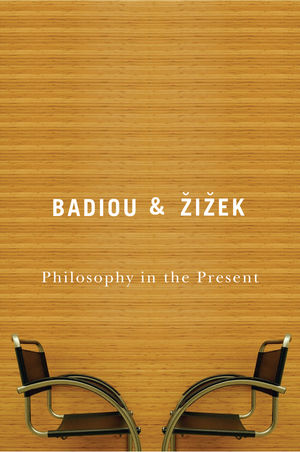 Philosophy in the Present (Polity, 2009) is a recent translation of talks given by Badiou and Zizek in Vienna in 2004 and published in German in 2005 as Philosophie und Aktualität. Ein Streitgespräch.
I'm not going to give a review of either Badiou's or Zizek's contributions, because much of what they say has been taken up by them in other works. Badiou offers some initial comments about the conditions of philosophy (if you haven't heard, they are politics, art, mathematics and love), and then he reproduces his "Eight Theses on the Universal," published previously in Theoretical Writings (edited by Ray Brassier and Alberto Toscano, Continuum, 2004).
Zizek's essay largely re-affirms Badiou's stance in general, and presents his argumentation for why we should reject the concept of totalitarianism: that it presents a false equivalence between the egalitarian project of communism and fascism. In addition, the concept of totalitarianism, for Zizek, blocks a more "appropriate socio-politicial theory with which we can analyse these of course deplorable phenomena like Nazism and Stalinism in their own conceptuality as projects" (57). Basically themes that have been treated more extensively in his other work (like, I suppose, Did Somebody Say Totalitarianism?).
The discussion between the two is more entertaining than it is a contentious debate.
Despite the repetition, or because of this repetition is here more accessible, Philosophy in the Present is being touted as an introduction to Badiou and Zizek. However, I don't think it is very useful in this function, not just because the texts are unpolished, or that they don't introduce new material, but primarly due to Peter Engelmann's introduction. Keep in mind what I have said above, and read:
It was not after all very long ago that we talked about what the role of the philosopher Karl Marx had been in the totalitarian regime of Russia, and later the countries of the Soviet bloc. Wasn't the mass murderer Pol Pot an intellectual educated in Paris? How many people were humiliated, expelled and murdered during the Chinese Revolution? [...] the participation of intellectuals in the crimes of the twentieth century weighs heavily on the self-understanding of this social group, at least insofar as it maintains a practical memory of history (viii-ix).Now, is not the purpose of an introduction to introduce something of either Badiou or Zizek's theory of political commitment? Because this passage ignores, or is a deliberate evasion of, both of their extensive bodies of work, which reject the ideological frame that naively blames intellectuals for political purges or that assumes consensus around the meaning of the Chinese Revolution, not to mention the false equivalence of Marx, who did not live to see any communist state revolutions, with Pol Pot, other intellectuals, or obviously Mao. I find it bizarre, and disappointing, that two philosophers who are sharply critical about revisionism (like Badiou's unapologetic position about his Maoism) let a book be published that is prefaced by such revisionism.
A more honest, and more productive, procedure for the introduction isn't to critique intellectuals for their participation in leftist politics, but ask how intellectuals continue to participate in maintaining and affirming the status quo of liberal democracy. This question isn't too abstract, being that the French media created the nouveaux philosophes, and it actually functions to introduce something of what makes both Badiou and Zizek interesting, rather than recycle platitudes about leftist intellectuals.
Thus, for introductions, instead, I recommend Badiou's Ethics, and perhaps Zizek's most current title (but the clock is ticking...) First as Tragedy, then as Farce (our review is here), or, of course, The Sublime Object of Ideology.
Sunday, January 10, 2010
Virtual Badiou
 There's nothing like catching up on correcting exams to ruin a weekend. That's what I get for putting it off until the last minute. However, you don't have to let it ruin your weekend. Matt can be found here, writing about Osamu Dazai, and Jason discusses miscegenation in the colonial context. Or, you can check out Alain Badiou's new website, http://alainbadiou.fr, which at the moment is promoting his forthcoming La philosophie et l'événement, a series of discussions with Fabien Tarby. It also has a link to a debate, published in Le nouvel observateur, between Badiou and Alain Finkielkraut.
Wednesday, November 18, 2009
First as Tragedy, then as Farce

Slavoj Zizek's new book (Verso, 2009) examines the current world financial crisis and attempts to delineate a coherent Leftist response. The book is relatively accessible, and readers frustrated by his unruly and largely redundant previous effort In Defense of Lost Causes will find Zizek back in top critical form.
The current crisis is read in light of a comment of Marx's, to the effect that historical events must occur twice: first as tragedy, then as farce. September 11, 2001 (treated previously by Zizek in the engaging Welcome to the Desert of the Real, Verso 2002) was the tragic moment showing the naive utopianism of the Fukuyamean/Clintonite "happy 90's"; the bailout of banks and manufacturers by Congress is its farcical repitition (farcical because, among other things, it answers this naive utopianism with the spectacle of failed millionaires being put on a kind of welfare). As always, Zizek zeroes in on the counter-intuitive features of his historical conjuncture - the populist Right is after the wrong targets, the liberal Left is shoring up the big companies - with a view to unmasking their ideological core.
The second half of the book concerns the "communist hypothesis" (Badiou's term) in the present conjuncture. The communist hypothesis, discussed by Badiou in recent texts, is the hypothesis that communism is the right political solution (accepting, of course, that attempts to work it out have hitherto failed). Zizek bets on this hypothesis; he emphasizes however that whereas both Actually Existing Socialism and contemporary liberal capitalism belie an utopian core, his communism is not guilty of a happy Hegelianism that would count history on its side. Rather, Zizek maintains that the Left should assume a coming social / environmental / biogenetic catastrophe, and work backwards to how it might have been stopped. In short, Zizek sees the task of the Left as stopping history in its tracks by communist means and for communist aims. One sees again his affinity for Lenin, who it will be recalled was a voluntarist, strategic reader of Hegel.
Some of the prescriptive vagueness of In Defense of Lost Causes is repeated here, but I believe that Zizek gives the outline of what could prove a compelling philosophical argument for a communist response. He lives up to his reputation for weaving philosophy, pop culture, politics and psychoanalysis into an engaging whole; ultimately, however, the philosophical meat of his arguments is to be sought in earlier texts (now on Verso as "The Essential Zizek").
Tuesday, November 3, 2009
Alberto Gualandi's "Lyotard"

I'm writing my doctoral dissertation on J-F Lyotard. That means I spend a lot of my time wading around in a body of secondary literature of vastly divergent quality. The problem is that Lyotard's corpus is so unruly; he's stylistically divergent, covers a wide variety of topics, consciously resists systematic readings of himself, and even seems on certain crucial points to maintain contradictory positions. This ensures that his commentators have their work cut out for them; it also ensures that those without much to add sometimes slip through the cracks and get a more serious hearing than might be expected. Granted, there are a number of texts which are supposed to introduce Lyotard to the novice reader and which, in my estimation, do a pretty darn good job; on the other hand, however, I've read my share that I think risk creating further confusion. How exactly does one introduce a thinker who at bottom stood for the inability to sum things up?
Alberto Gualandi, in my view, does an admirable job where many others have failed. He reads Lyotard against the ancient distinction between the philosopher and the sophist, ultimately concluding that Lyotard occupies an ambiguous position between - or rather, that he shows how the distinction is perhaps drawn a bit too neatly in the history of philosophy. This reading, fleshed out by Gualandi, helps ease the reader into the strangeness and originality of Lyotard's corpus. It's also interesting when considered against Badiou's reading, wherein Lyotard is taken to be a sophist, but therefore an indispensable discursive partner to the philosopher (and therefore, not due to be expelled from the ideal city).
Alberto Gualandi, in my view, does an admirable job where many others have failed. He reads Lyotard against the ancient distinction between the philosopher and the sophist, ultimately concluding that Lyotard occupies an ambiguous position between - or rather, that he shows how the distinction is perhaps drawn a bit too neatly in the history of philosophy. This reading, fleshed out by Gualandi, helps ease the reader into the strangeness and originality of Lyotard's corpus. It's also interesting when considered against Badiou's reading, wherein Lyotard is taken to be a sophist, but therefore an indispensable discursive partner to the philosopher (and therefore, not due to be expelled from the ideal city).
Most importantly, perhaps, Gualandi takes care not to speak in Lyotard's language (or something resembling it too closely). As far as possible, he gives a clear, concise, roughly chronological account of Lyotard's main contributions to philosophy, without falling into the trap of assuming "the master's" discourse and methods.
I should also add that Gualandi's book is in French. If you can read the language, count this as a good introductory source.
Thursday, October 22, 2009
My mom is reading Badiou's "The Century"

So I went to Paris with my mother back in June to celebrate her 50th. Had a great time, naturally. While there I picked up some titles by Alain Badiou, French philosopher of math/ontology and (Ultra-gauche) communist stalwart.
Having acquired there and quickly read Badiou's scathing recent book on Sarko, I passed it off to my mom, who has been slowly educating herself in philosophy ever since I started talking about it at the dinner table. She got a huge kick out of it, and went off to a local independent book seller to see what other titles this Badiou guy has on offer. She decided on "The Century", which I can tell you nothing about other than the fact that Badiou is talking about the epoch lasting from WW1 to the fall of actually existing socialism in the East. She is reading through it and occasionally gives me updates. She also plans to tackle his book on the idea/hypothesis of communism.
The point of this post is to flag the uncomfortable fact that my mom is slowly catching up to me in reading Badiou; perhaps one day she'll surpass me. Soon I'll be home for Christmas and I'll say something like "Mom, can you pass the salt?" and she'll say something like "The logic of the situation may only be interrupted by your fidelity to the event opening onto salt-having". And that won't necessarily be a bad thing, but I expect it will make my trips home less about r and r, and more about mathematically grounded communist militancy.
Subscribe to:
Posts (Atom)