Schelling is often thought to be a protean thinker whose work is difficult to approach or interpret. In Freedom and Nature in Schelling’s Philosophy of Art, Devin Zane Shaw shows that the philosophy of art is the guiding thread to understanding the relationships between three of Schelling’s original contributions to philosophy as they are expressed in his work from 1795-1810: his idea of freedom, his philosophy of nature, and his philosophy of art. Schelling’s idea of freedom is developed through a critique of the formalism of Kant’s and Fichte’s practical philosophies, and his nature-philosophy is developed to show how subjectivity and objectivity emerge from a common source in nature. The philosophy of art plays a dual role in the system. First, Schelling argues that artistic activity produces through the artwork a sensible realization of the ideas of philosophy. Second, he argues that artistic production creates the possibility of a new mythology that can overcome the socio-political divisions that structure the relationships between individuals and society. Shaw’s careful analysis shows how art, for Schelling, is the highest expression of human freedom.
Wednesday, March 31, 2010
Schelling's Philosophy of Art in a Nutshell
Or, the most recent draft of the cover copy of my book:
Schelling is often thought to be a protean thinker whose work is difficult to approach or interpret. In Freedom and Nature in Schelling’s Philosophy of Art, Devin Zane Shaw shows that the philosophy of art is the guiding thread to understanding the relationships between three of Schelling’s original contributions to philosophy as they are expressed in his work from 1795-1810: his idea of freedom, his philosophy of nature, and his philosophy of art. Schelling’s idea of freedom is developed through a critique of the formalism of Kant’s and Fichte’s practical philosophies, and his nature-philosophy is developed to show how subjectivity and objectivity emerge from a common source in nature. The philosophy of art plays a dual role in the system. First, Schelling argues that artistic activity produces through the artwork a sensible realization of the ideas of philosophy. Second, he argues that artistic production creates the possibility of a new mythology that can overcome the socio-political divisions that structure the relationships between individuals and society. Shaw’s careful analysis shows how art, for Schelling, is the highest expression of human freedom.
Any suggestions? I'm sending it off by the end of the week. The final draft, which differs somewhat from this version, is here. See my posts on Schelling here (part one and part two).
Schelling is often thought to be a protean thinker whose work is difficult to approach or interpret. In Freedom and Nature in Schelling’s Philosophy of Art, Devin Zane Shaw shows that the philosophy of art is the guiding thread to understanding the relationships between three of Schelling’s original contributions to philosophy as they are expressed in his work from 1795-1810: his idea of freedom, his philosophy of nature, and his philosophy of art. Schelling’s idea of freedom is developed through a critique of the formalism of Kant’s and Fichte’s practical philosophies, and his nature-philosophy is developed to show how subjectivity and objectivity emerge from a common source in nature. The philosophy of art plays a dual role in the system. First, Schelling argues that artistic activity produces through the artwork a sensible realization of the ideas of philosophy. Second, he argues that artistic production creates the possibility of a new mythology that can overcome the socio-political divisions that structure the relationships between individuals and society. Shaw’s careful analysis shows how art, for Schelling, is the highest expression of human freedom.


Saturday, March 27, 2010
When Afghanistan Was On the Side of God and Freedom
People educated about Cold War politics know that the US supported Afghanistan (or certain groups opposed to communism in Afghanistan) in its struggle against the 1979 Soviet invasion of their country. It is still surreal to observe the way US leaders portrayed the war. Watching President Jimmy Carter's National Security Adviser Zbigniew Brzezinski tell Afghan resistance fighters that God is on their side remains ironic. President Ronald Reagan championing Afghan freedom juxtaposed to the advances of science and technology appears curious to viewers living in 2010. This seems unbelievable given the language that has emerged from the US government since the time of it invading Afghanistan in 2001. These videos reveal the meaninglessness behind politicians rhetoric in regards to wars and military occupations.
(I should mention that whoever edited the the clip with Zbigniew Brzezinski addresses the Afghans at the beginning as the Taliban. Most likely these are not Taliban fighters because the Taliban formed later in the 1990s.)
(I should mention that whoever edited the the clip with Zbigniew Brzezinski addresses the Afghans at the beginning as the Taliban. Most likely these are not Taliban fighters because the Taliban formed later in the 1990s.)
Thursday, March 25, 2010
On The Second Sex

"There is a good principle which has created order, light, and man, and a bad principle which has created chaos, darkness, and woman." ~Pythagoras
"All that has been written about women by men should be suspect, for men are both judges and interested parties." ~Poullain de la Barre
So run the two epigrams to The Second Sex, which do not appear in H.M. Parshley's translation. Just as "It is clear that no woman can claim, without bad faith, to situate herself beyond her sex" is deleted from its rightful place after this passage:
Surely woman is, like man, a human being; but such a declaration is abstract. The fact is that every concrete human being is always a singular, separate individual. To decline to accept such notions as the eternal feminine, the black soul, the Jewish character, is not to deny that Jews, Negroes, women exist today – this denial does not represent a liberation for those concerned, but rather a flight from reality (p. xx).
These omissions, and others (about 15% of the book by Toril Moi's estimation), along with Parshley's lack of command over the 'existentialist' vocabulary detract from such an important work of philosophy. Which is why many de Beauvoir scholars demanded a new, complete translation. In 2007, after years of resistance, the publishers of the English translation announced that a new translation would be forthcoming, and it appears that the news was received with caution. As Toril Moi writes, before the translation had appeared, "The translators, Constance Borde and Sheila Malovany-Chevalier, are best known as cookery book writers. Let's hope they do justice to Beauvoir's masterpiece."
Now, in the London Review of Books, in an article entitled "The Adulteress Wife," Moi renders the verdict:
The best I can say about the new translation of The Second Sex is that it is unabridged, that some of the philosophical vocabulary is more consistent than in Parshley’s version, and that some sections (parts of ‘Myths’, for example), are better than others. The translators claim that their aim was to bring ‘into English the closest version possible of Simone de Beauvoir’s voice, expression and mind’. The ambition is laudable, but the result is what Nabokov, a great champion of literal translation, called ‘false literalism’ (as opposed to ‘absolute accuracy’). The obsessive literalism and countless errors make it no more reliable, and far less readable than Parshley.
Whenever I try to read Borde and Malovany-Chevallier’s translation like an ordinary reader, without constantly checking against the French, I feel as if I were reading underwater. Beauvoir’s French is lucid, powerful and elegantly phrased. Even in Parshley’s translation young women would devour The Second Sex, reading it night and day. It’s hard to imagine anyone doing that with this version.
In her article, she proceeds through a long list of problems with the translation, which I will leave to the reader to explore (they still make me panic about my own translations that I rendered above on the fly...).
Why my interest? I teach de Beauvoir in my "Great Philosophers" class, and this task is rendered a bit more difficult by having to reconstruct her argument, and her philosophical terminology against Parshley's translation. It's not heartening to hear that the trade off of the new translation is that it renders this vocabulary more consistent at the price of readability. It's too bad, because the discussion of de Beauvoir's work often brings the class to life a bit, due to its relevance to contemporary life (which is both good and bad: good because her criticisms remain lively, astute, and, for some, empowering, but bad because many of the problems faced by women-- and others-- sixty years ago are still problems for women today).
I've been thinking of switching to a different text, from the "Introduction" to The Second Sex to something else, more than likely the Ethics of Ambiguity. Any suggestions?
Wednesday, March 24, 2010
Yukio Mishima, "Runaway Horses"
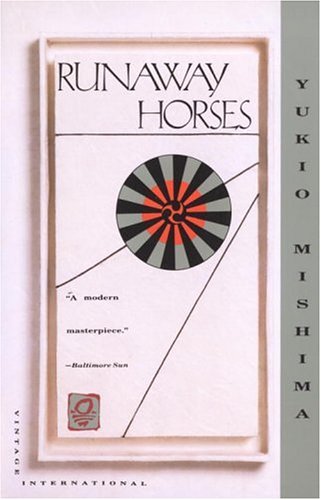
(Vintage International, 1990)
Runaway Horses is the second book of Mishima's "Sea of Fertility" tetralogy, in which a single character, over the course of his life, is confronted with three incarnations of a dead school friend. Mishima is generally regarded as one of twentieth century Japan's greatest authors, but his legacy has been troubled. It's well known that he formed a cartoonish ultranationalist militia bent on protecting the emperor, and that he met his end committing seppuku after a failed attempt to rouse a military garrison into a rightist coup. It's also well known that he practiced kendo, lifted weights, frequented gay bars, and liked to have glamour shots of himself taken in which, among other things, he posed as St. Sebastien. When Runaway Horses was written in 1969, Mishima was increasingly viewed as an embarrassing anachronism, if not a dangerous figure of the extreme right.
Let's call a spade a spade: Mishima was a fascist author, or at least he would have liked to have been one. In this respect, Runaway Horses reads at times as Mishima's political manifesto. The context of the novel is Japan in 1931-32. The main character is a young kendoist who forms an ultrnationalist league with his schoolmates. They plot to assassinate the country's leading capitalists and then commit seppuku, in a bid to restore full legislative and executive powers to the emperor. The young men are very "pure". In fact the word "purity" appears so many times in the novel that it becomes annoying and almost meaningless (though it's interesting to note that at times it seems to mean something like Dostoevsky's Underground Man's notion of gratuitousness). In fact, purity in the hands of the league seems to pass over into pure vanity. I never realized how boring, mincing and petty fascism can be.
The novel is still somewhat interesting, however, because in the end the main character passes over from ultranationalism to nihilism. I won't ruin it for you, but anyone with an interest in Mishima's own bizarre biography can look to Runaway Horses for a clue. As I've already suggested, Mishima would have liked to have been a fascist. But one senses that when marching around in military garb he was not being honest with himself, that there's really something else going on. Though the novel is long and largely boring, it does speak to the possibility of believing in things, of purity even, in late modernity. And I think its assessment is profoundly negative.
Happy reading?
Saturday, March 20, 2010
Not in Our Name: Who are We? Who is Obama?
Today I'm tired and somewhat annoyed. US President Obama campaigned that he would bring change. Can we all agree he is a catastrophic disappointment? He did once talk about change in a convincing way, it looks like he changed his mind. The anti-war movement needs to come at Obama with the same anger that was meted out on former President George W. Bush. Obama's health care "reform," if it passes, will be making uninsured Americans forced to buy health insurance? Instead of better health care and greater access we will me under an even tighter grip by the insurance industry. The US government's problems go far beyond individuals in power. Corporate interests rule. I thought a short clip of the slam poet Saul Williams giving a "Pledge of Resistance" would be appropriate. It just needs to be updated.
Friday, March 19, 2010
Immanence and Atheism
I've been preparing, over the last month, for a talk I am giving at the University of Toledo on Deleuze and Spinoza. After finishing the penultimate draft of my MA thesis at the aforementioned university (in 2002; I defended in March 2003), I spent some time reading some of the more contemporary figures in French and Italian philosophy, which included Giorgio Agamben, Alain Badiou, and What is Philosophy? by Deleuze and Guattari. I thought it would be appropriate to return to some of them when I return to give a talk in Toledo.
The talk I am giving next week deals in part with what Deleuze* calls the 'plane of immanence.' He argues that philosophy is the creation of concepts, which has become somewhat of a motto for some Deleuzians, but what is more difficult is figuring out what he means by setting out, instituting, or tracing, a plane of immanence. There are several problems with the proliferation of his 'modes', as it were, of explaining immanence but I am going to leave them aside just to mention one of the compelling reasons in favor of his argument.
The third example of What is Philosophy? reorders the history of philosophy from the point of view of the institution of the plane of immanence. Much of this history becomes a refusal of thinking immanence in favor of contemplation (of the Object), reflection (of the Subject) and communication ('with' the Other); each of those capitalized nouns representing a figure of transcendence. According to Deleuze, these transcendent figures are reappear in philosophy because they are illusions that arise on the plane of immanence. The decisive move is to attach the problem of immanence to the problem of the revaluation of values. The conceptual link gives us a clear way to assess why immanence has been rejected by so many philosophers, and why so many have attacked the naturalism of Spinoza to 'save' freedom, because from the standpoint of transcendent values, all other values appear nihilistic, while from the standpoint of immanence, all transcendent values are illusory.
My question is whether or not 'immanence' is the best approach to talking about the philosophical commitments of atheism. An atheist cannot have recourse to supernatural or transcendent explanations or values, and I think immanence captures this. Nevertheless, it seems that Deleuze's plane of immanence neutralizes the divine name while keeping the image of the One-All. It's not even clear if Deleuze maintains a materialist position (this is something like Hallward's critique), so even Spinoza's naturalism might be more strict and more minimal that Deleuze's philosophy. Atheism and materialism reject transcendence, but which concepts are required to think immanence if the One-All won't work? While I can't go into it here, there are at least two options: contingency and inconsistency. Or even possibly the often rejected concepts of necessity or determination. In addition, no matter which concepts 'work', so to speak, there remains the question of relinking these conceptual questions to historical materialism.
*I am leaving aside Guattari, not because I think his approach should be separated from Deleuze's, but because I am also going to critique Deleuze's work on Spinoza. François Dosse's Gilles Deleuze et Félix Guattari, biographie croisée also claims that much of What is Philosophy? was written only by Deleuze (pp. 538-539).
Wednesday, March 17, 2010
Catharine Grant, "The No-Nonsense Guide to Animal Rights"

(Between the Lines, 2006)
This May I'll be teaching a mini-university enrichment course to Ontario and Quebec students from grades 8 to 11. The course I've designed is called "Philosophy and Animal Rights". The students will be introduced to some basic questions and themes of philosophy by thinking about animals. Roughly, we'll look at metaphysics (is there an ontological disctinction between humans and animals? Is there an evolutionary ladder?), epistemology (how do we know what animals are thinking and feeling, if anything? How do we know what other people are thinking and feeling, for that matter?), and of course, ethics (where do right and wrong come from? Are there moral limits to what we can do to an animal? Are animals inherently valuable, valuable relative to human concerns, or both?). It should be said that I'm a vegan (with some freegan tendencies, to be sure!), so there is certainly a danger that this introduction to philosophy will turn into animal rights propaganda. But then I expect the students who chose this course over the others offered are already to some extent curious about or even committed to questions of animal rights. It should be interesting to see how these dynamics play themselves out.
In preparing for the course, I've found an invaluable resource in Toronto scholar and activist Catharine Grant's "The No-Nonsense Guide to Animal Rights". The No-Nonsense Guides comprise a series which, though I haven't read them all, gives me an overall positive impression. Grant's contribution in particular is wonderfully succinct and, true to its title, no-nonsense. She gives a basic understanding of the distinction between animal welfare and animal rights views, the main moral arguments surrounding animal rights (i.e. Singer and Regan), and provides a wealth of information about the true costs, to animals, humans, and the environment, of the various animal industries. She also gives organic husbandry its due, though she flags it as problematic. Best of all, she argues that animal rights activism is neither necessarily the province of affluent Northerners, nor ignorant of interlocking systems of oppression. She takes an anti-corporate, arguably anti-capitalist stand against animal industries, and thereby situates the struggle against them with respect to wider struggles for social justice.
In short, Grant's book is excellent. Those who are curious about animal rights, but who don't have the time or energy to pore over such paving stone sized volumes as Regan's The Case for Animal Rights, need look no further.
Teaching Marx, Part 2
As I mentioned before, I spent a few days teaching Marx to my Great Philosophers class. The first day was dedicated to a bit of intended disorientation for them, while on the second, we looked at the Preface to A Contribution to the Critique of Political Economy (here). I will spare you my notes, but I discussed how this text has an ambivalent place in many interpretations of Marx; while it provides a concise statement on historical materialism, it seems to veer toward a deterministic account of social change. The voluntarist side of Marxism, to which I incline, is often forced to reject Marx's strict distinction between base and superstructure, or to reject passages such as
No social order ever perishes before all the productive forces for which there is room in it have developed; and new, higher relations of production never appear before the material conditions of their existence have matured in the womb of the old society itself. Therefore mankind always sets itself only such tasks as it can solve; since, looking at the matter more closely, it will always be found that the tasks itself arises only when the material conditions of its solution already exist or are at least in the process of formation.
Now, I feel fairly ambivalent about these kinds of passages, because while they seem to endorse an economic determinism, they also seem to support Marx's argument that changes that do not affect the base will not lead to liberation. However, by removing the subjective aspect of social struggle, they seem to describe better the transitions from one capitalist superpower to another: once one economic center's productive forces are fully developed and become an impediment to further development, another economic center takes its place.
I have, nevertheless, started rethinking my take on the distinction between the base and the superstructure. This division is often criticized for making the superstructure (political, intellectual and social life) dependent on the economic base.
Unlike many of the other approaches that historicize social forms, historical materialism requires that these forms must be understood as embedded in capitalist and imperialist forms of social relationships. Furthermore, we ought to look at how the financialization of capitalism produces a failure of meaning in the transition from economic forms to forms of political struggle. By this I mean that radical political struggle, and radical philosophy, has not yet 'mapped' these new social relations and organized clear political demands to change these relationships, which is why so much of the critique of finance capitalism has focused on bankers or has demanded administrative solutions to financial crises. This is not enough. As Christian Marazzi points out, in The Violence of Financial Capitalism, reform must start at the base. This means questioning assumptions about consumption, production, and investment in new ways. Marazzi argues that reform at the base ought to return the right of social ownership to the forefront of criticism. His specific example is the right to housing as a social right rather than a private right, but we could also add better financial access to education and intellectual commons, amongst other things.
Tuesday, March 16, 2010
Reminder: CFP: The Future of Sartre's Critique
Just a reminder that the deadline for our call for papers for "The Futures of Sartre's Critique" is coming up. Here's the information (with an extended deadline):
In April 2010, The Notes Taken will be publishing a series of short reflections dedicated to the futures of Sartre's Critique of Dialectical Reason, to begin with the date of publication (for the first volume) given by Contat and Rybalka's Les écrits de Sartre, 6 April 1960. Being that we have a small set of dedicated writers, we have decided both to invite contributions and to extend a call for papers to our readership.
We are looking for contributions that focus on the later work of Sartre, including his work on colonialism, politics, Flaubert and, of course, the two volumes of the Critique of Dialectical Reason. The papers need not be formal, they need only to show clearly how Sartre's philosophy can contribute to rethinking radical and emancipatory politics.
The deadline is March 24th, 2010.
Saturday, March 13, 2010
Nazim Hikmet: Marxist Turkish Poet Set to Music
In 2001 the famous Turkish pianist Fazil Say composed an orchestra piece titled "Nazim." Nazim Hikmet Ran was a Marxist Turkish poet that suffered much for his politics that he infused into his poetry. In 1938 he was arrested for inciting the Turkish military to revolt. Hikmet's sentence was twenty-eight years in prison. Turkish authorities stated that his poetry was inspiring subversion. By 1949 Pablo Picasso, Paul Robeson, and Jean-Paul Sartre, along with others, campaigned for Hikmet's release from prison. In 1950 Hikmet was set free. ( See Poems of Nazim Hikmet trans. Randy Blasing & Mutlu Konuk, New York: Persea Books, 2002, xiv,xv) Before his death Hikmet's life remained dangerous and turbulent while his poetry became more influential.
I have two clips from Say's "Nazim." The first is a powerful rendition of Hikmet's ability to have used art against US Imperialism and a corrupt Turkish state. The second video is from his internationally celebrated Kız Çocuğu (The Little Girl), otherwise known as "Hiroshima Child/Girl." This poem is about a dead girl after the atom-bomb that dropped on Hiroshima in Japan. The musical accompaniments Fazil Say uses make these powerful poems come to life.
I have two clips from Say's "Nazim." The first is a powerful rendition of Hikmet's ability to have used art against US Imperialism and a corrupt Turkish state. The second video is from his internationally celebrated Kız Çocuğu (The Little Girl), otherwise known as "Hiroshima Child/Girl." This poem is about a dead girl after the atom-bomb that dropped on Hiroshima in Japan. The musical accompaniments Fazil Say uses make these powerful poems come to life.
Subscribe to:
Posts (Atom)