Showing posts with label US Empire. Show all posts

Sunday, January 8, 2012

Rick Santorum: Christian Nuclear Bombs are Better Than Islamic Ones

Republican Presidential hopeful Rick Santorum is enthusiastically ready to go to war with Iran if they pursue attempts to go nuclear. According to him, at the Republican debate in Concord, N.H., an Islamic theocracy is more dangerous with a nuclear bomb than a Christian (US), atheist (former Soviet Union), or Jewish state (Israel). He does not explain it explicitly that way, but it is certainly implied. Robin Abcarian, in the January 8, 2012 Los Angeles Times writes:
Moderator David Gregory noted that the United States has lived with a nuclear Soviet Union and a nuclear North Korea. “Why is it we cannot not live with a nuclear Iran?” he asked. “And if not, are you prepared to take the country to war to disarm that country?”

Iran, said Santorum "is a “theocracy that has deeply embedded beliefs that the afterlife is better than this life . When your principal virtue is to die for Allah, then it’s not a deterrent to have a nuclear threat . It is in fact an encouragement for them to use their nuclear weapon.”
He is hinting that Iran has a suicide-bomber mentality: that Islam inclines the use of the nuclear bomb. It should be noted that the US, a mainly Christian state, is the only country to have dropped nuclear bombs (killing over 200,000 civilians). [Updated:] There are debates about the actual reasons and reactions made by the US government during WWII against Japan. The US government's official reason for bombing Japan was because Japan started a war with the US. Japan used suicide bombers, though I don't recall that the Japanese religion promised virgins in the afterlife as a reward by Allah for their mission (side note: The Persian/Iranian word for God is Khoda, although Allah is used at times).

I usually never recommend Wikipedia as a source but its page on the history of suicide attacks gives an interesting perspective to this ignorant Islamophobic statement by Santorum. I would like to make it clear that I'm nuclear-bomb phobic and would like them all to be dismantled. I simply think it is really hypocritical that nuclear powers such as the US and Israel to tell Iran they can't have one. Every nation that attains a nuclear bomb is a "suicide attacker" state.

This video I'm posting, "History of U.S. Intervention in Iran - 1953 Until Present," is a must see. I don't believe there is one point made that is debated by historians.

Sunday, December 4, 2011

Dr.Strangelove, Iran, the US, and Israel

Today, Sunday December 4, Iran claims it has shot down a an unmanned American drone over its eastern territory. David Goldstein of McClatchy Newspapers reports:
The incident comes at a time of rising tension with Iran over its nuclear enrichment program. Tehran insists that the program will be only for domestic use, but Western nations and Israel, in particular, remain highly skeptical and worry that the true purpose is to develop nuclear weapons.
The real concern is not about Iran attacking the US or Israel. The issue is Iran being a nuclear big-shot just like Israel and the US. Israel is so concerned that they might attack Iran with or without US help or approval. The Israeli news source Haaretz shows how Israeli Prime Minister Netanyahu is drumming up for war. He publicly stated:
"Great statesmen as well as friends of the Jews and of Zionism" warned Ben-Gurion that declaring a Jewish state in 1948 would bring an invasion of Arab armies and a "grave and difficult battle", Netanyahu said.

"He understood full well the decision carried a heavy price, but he believed not making that decision had a heavier price," Netanyahu said. "We are all here today because Ben-Gurion made the right decision at the right moment.”
In other words, even though the US and some Israeli officials are telling him attacking Iran is a bad idea he still may do it. O what a dangerous political game. Who is advocating suicide bombing now?

Since US President Bush, several messages have been received by enemies of the US (and to some of its allies such as Israel). If a country does not possess weapons of mass destruction it can and will be invaded. Iraq knows best. If a country stops its nuclear program and cooperates with the US, along other Western powers, it can still get invaded and bombed. As Qaddafi of Libya learned the hard way. What Iran knows is that it may get attacked with or without nuclear weapons, but it most certainly will not get attacked if it does have them. This is why countries go nuclear. It is supposed to be a deterrent. It's a gamble. Every nation with these weapons of mass destruction play a risky game of "Russian" roulette. The ones that already have them can also get delusional. Netanyahu thinks he is Ben-Gurion ready to take risks and recreate Israel despite all odds. I refer him to Karl Marx's thoughts on Louis Bonaparte:
Hegel remarks somewhere that all great world-historic facts and personages appear, so to speak, twice. He forgot to add: the first time as tragedy, the second time as farce.
Netanyahu is a farce. He acts as if he'll keep stability and peace in the region. It looks like he may set off another goddamned war.

I thought a clip from Stanley Kubrick's Dr.Strangelove(1964) would be quite fitting.

Saturday, November 19, 2011

Obama and US Military in Australia

Nobel Peace Prize winner US President Obama continues to rival former US President Bush in maintaining and expanding US Empire. The US will be committing it's military presence to Australia. According to the news agency Reuters:
The U.S. deployment to Australia, the largest since World War Two, will start next year with a company of 200-250 marines in Darwin...

A total of 2,500 U.S. troops would eventually rotate through the port city. The United States will bring in ships, aircraft and vehicles, as well as increase military training.
For what purpose? The Chinese see this as a provocation. What is certain is that the US views itself as the necessary leader to be involved in economic and political affairs throughout the region. The same article continues:
China claims the entire maritime region, a vital commercial shipping route rich in oil, minerals and fishery resources. It insists that any disputes be resolved through bilateral talks and says Washington has no business getting involved.

"The United States is also trying to get involved in a number of regional maritime disputes, some of which concern China's sovereignty and territorial integrity," a commentary from China's official Xinhua news agency said.

Vietnam, the Philippines, Taiwan, Malaysia and Brunei hold rivals claims to at least parts of the sea and tension occasionally flares up into maritime stand-offs.

Obama will make an "anchor speech" outlining the U.S. vision for the Asia-Pacific to the Australian parliament on Thursday before a whistle stop in Darwin. He then flies to the Indonesian island of Bali for the East Asia summit.
So here we have it, the US is overtly the official policeman of the world. While the US economy sinks there will be plenty of US Navy ships keeping float: less bread for more iron and steel. I thought this kind of distorted sense of priorities is what the North Korean government has been accused of doing. I forgot, Kim Jong-il never got the Nobel Peace Prize.


Saturday, July 24, 2010

US-South Korean Relations, A Dynamic Affair


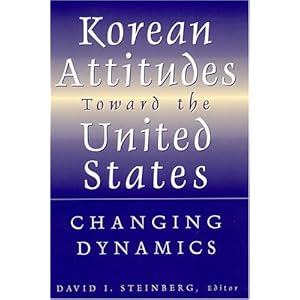
I’ve only just arrived in Korea about five weeks ago. I don’t want to live obliviously as so many Americans seem to do here. With this in mind I set out to learn some of the history of Korea and some of its culture. I’ve digested a short course of books on the country and also on the city in which I live. Given Hillery Clinton’s visit to Korea in the past days and the George Washington, a US supercarrier, conducting war games off of the coast of South Korea’s port city of Busan one of these books seems more relevant right now. Edited by David Steinberg of Georgetown University, Korean Attitudes Toward the United States: Changing Dynamics, published in 2005 by M. E. Sharp Inc., presents a primer for contemporary South Korean international outlooks. Though many professional academics have contributed to the work I would like to note at the outset that most of them seem to begin their appraisal of these relationships from a strongly biased opinion in favor of the continuation of US military presence in South Korea. As I have learned since arriving here in Kwangju that regularly both pro-American and Anti-American protests rage here, I think this overwhelming bias within the book worth of note.

The book, to its editor’s credit is arranged extremely well. Each of its sections cover peripheral as well as pertinent topics from comparative studies and statistics to structural interpretations and diplomacy. Unfortunately their remains a vast dearth of anything remotely cultural. The cultural components of the book are purely explicative and only considered as secondary to international relations or else political conditions. These caveats aside the book has a lot of interesting data and explication to consider.

William Watt’s essay “Changing Perspectives in U.S-Korean Relations and the Rise of Anti-Americanism" by far out weighs the other chapters in terms of the mass of data available. The chapter consisted of a vast corpus of statistics on Korean attitudes. I particularly found the table on page 268 interesting. It suggests that South Korean public opinion remains balanced between its outlook on China and the US. Given that China’s economy continues to rise and the US continues to decline this table and others indicates that Sino-South Korean relations are becoming significantly stronger. While the presence of the US military in South Korean increases disputes over sovereignty within the peninsula, China continues to play the role only of economic partner. This enables China to continue to improve relations while the US seems to continue aggravate their ally. The US and Korean military alliance centers on a fear of Kim Jong Il’s impotent aristocracy. This alliance does not fuel the aggravation but the perpetuation of US bases inside South Korea does for a portion of the population.

Watt's Statistics also reveal other striking, and for me surprising, statistics. For example a table on page 274 show that of those surveyed 59% think the US is the benefactor of the US-South Korean military alliance, with only 37% thinking that South Korea benefits. A statistic which bears relevance in my own politics jumps off of page 275: of "US led efforts to fight terrorism," 67% oppose and 13% favor. Given the emphasis in American media of the strength of the US-South Korean alliance, I found it quite revealing that Koreans largely oppose the US in its crusade. I found it a breath of fresh air. As several of my new friends here have explained, the invasion of Iraq and other 'counter terrorist' activities of the US in recent years have crossed many important political lines. Living in San Francisco these past years I had begun to think that only my friends therein quoted the Geneva Conventions, but I have had them referenced to me here as well.

Both citizens of the US and citizens the US's allies didn't see the Bush regime's invasion and occupation of Iraq as either justified or legal. Several less numeric data sets found their way into the study showing the reasons so many South Koreans grow cold over continued US military involvement on the Korean Peninsula from American egoism to US policies heightening South-North tensions. Of the last concern, many intoxicated Korean men have noted the desire to see all Korea eventually reunited into a single Korea. The political moves made by the US prevent this eventuality in the eyes of many people here.

William Drennen’s contribution unfortunately spends its pages attempting to find US hands clean of the disastrous and violent suppression of the people’s movement against the military dictatorship of Chun Doo Hwan: The Kwangju Massacre. I have had the opportunity to end up living in Kwangju, which has a massive park and memorial to remember the people lost in the military suppression. People I have spoken with who lived through the affair related seeing children beaten bloody and women raped in full view of the public. Furthermore, the military cut the telephone lines out of the city moments before they began their week long blood sport. This prevented neighboring cities and families from hearing of the full extent of the bloodbath. Other books I will review later explain that reporters on the scene later described the army‘s relentless battery of anyone within reach by sprint as "human hunting."

Drennen does a fairly inadequately researched outline of the violence which the people of Kwangju suffered in the days of murder by Hwan’s troops before a section he notably entitles “The Myth of US Responsibility.” Within this section he dismisses both American and Korean commentators as ignorant of the chain of command. This in his assessment leaves only Hwan's regime responsible. The facts, which he attempts to dismiss rhetorically remain that the South Korean military received a go ahead to conduct the operation entitled “Fascinating Vacations” from the US military. The critical point here is that while the US government often claims that it is taking military action to prevent humanitarian crisis to justify its own infractions against sovereign states and peoples, it could have just as easily and simply said that the operation couldn't be conducted to prevent this slaughter and didn't.

Other chapters are generally descriptive. Most indicate a growing movement of ‘anti-baseism’ or a growing desire to see US bases removed and full South Korean sovereignty brought to the now full fledged democracy. While these chapters tend to focus on the growing sentiment toward a desire to see the US military presence removed, the authors readily qualify that many South Koreans in fact remain desirous of a good relationship with the sole global military superpower. Though many here in South Korea rally for the removal of US bases from the Peninsula, others wear shirts bearing the US flag. Even those who have expressed negative opinions about the continuation of US presence in South Korea to me have often bought me a beer and even treated me to whole night out while discussing their political concerns. My own brief experience here has buttressed my appreciation of the expositions of this book.